
Route Optimizer: Complete Guide to Reducing Your Logistics Costs
Summary: A route optimizer reduces kilometers driven by 20 to 30%, cuts transport costs and improves customer satisfaction through intelligent route planning algorithms.
In France, road freight transport accounts for more than 89% of goods flows across the country. In this context, every unnecessary kilometer weighs on margins. A route optimizer has become a strategic lever for companies looking to streamline their operations.
Yet many organizations still plan their routes on spreadsheets or by instinct. The result: longer journeys, recurring delays and fuel costs that are hard to control. Understanding how a route optimizer works, what to look for when choosing one, and what concrete benefits it delivers enables better decision-making.
What Is a Route Optimizer and How Does It Work?
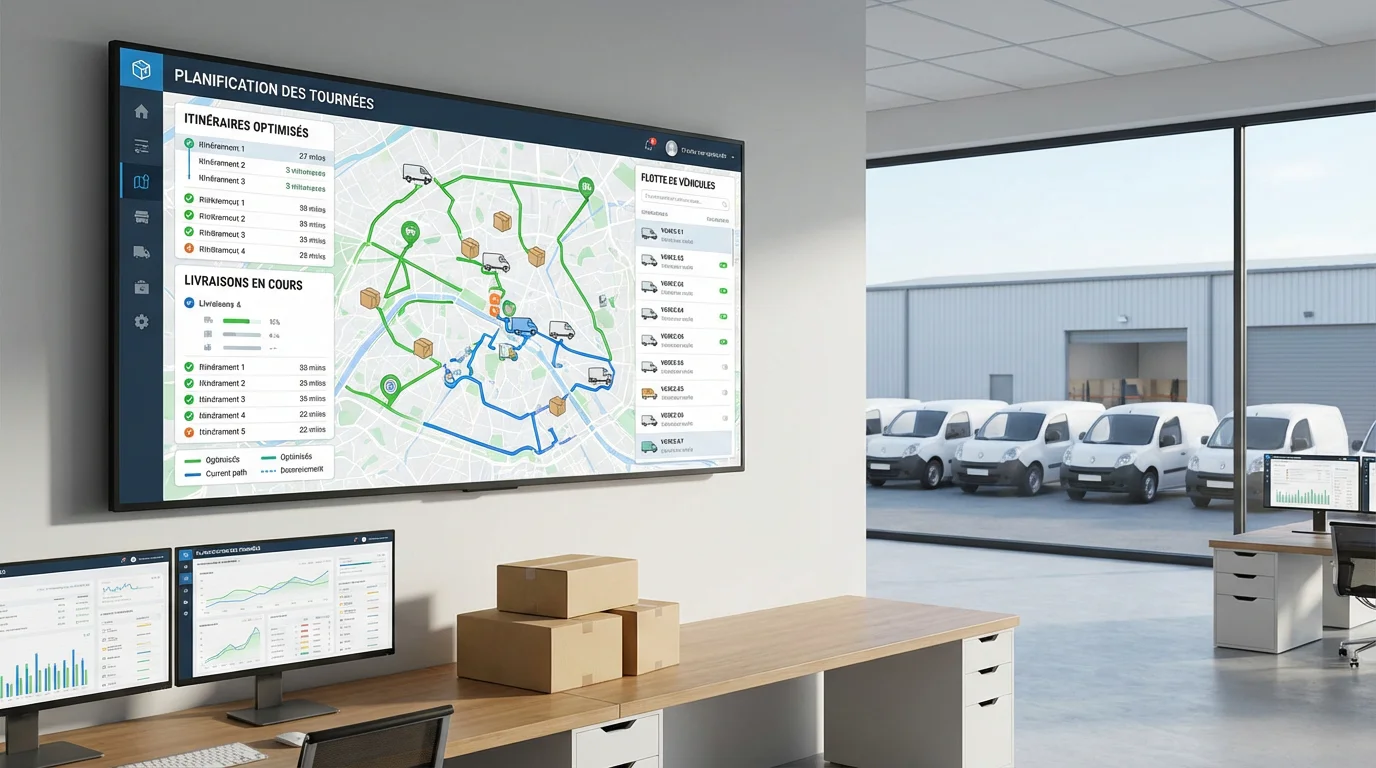
A route optimizer is software that automatically calculates the most efficient routes for a fleet of vehicles. It simultaneously integrates multiple parameters: delivery addresses, time windows, vehicle capacity, traffic conditions and regulatory constraints.
In practice, the software solves what mathematicians call the "travelling salesman problem", but at an industrial scale. In a matter of seconds, it evaluates thousands of possible combinations to determine the optimal sequence of stops.
Current solutions rely on combinatorial optimization algorithms (TSP, VRP and their variants) to continuously refine their calculations. They leverage real-time traffic data, historical journey data and weather forecasts. This adaptive capability sets a modern optimizer apart from a simple route planner.
The optimization engine accounts for multiple constraints: delivery windows stipulated by the customer, mandatory driver rest breaks, access restrictions (low-emission zones, weight limits) and even the specific skills of each driver.
Why Route Optimization Has Become Essential in France
The Union TLF, drawing on SDES figures, reports a 1.5% decline in logistics activity across 2024 compared to the previous year, and a 5.9% drop over two years. In a market under pressure, controlling operational costs is no longer optional.
In 2025, road freight transport accounts for approximately 24% of greenhouse gas emissions generated by transport, and nearly 7% of total national CO₂ emissions. Environmental regulations (low-emission zones, CSR objectives) are pushing companies to reduce their carbon footprint. A route optimizer contributes directly to this goal by eliminating unnecessary kilometers.
The growth of e-commerce and rising customer expectations around delivery timescales add further complexity. Delivering faster, at lower cost, while meeting environmental commitments: that is the equation solved by intelligent route planning.
The Concrete Benefits of Route Optimization Software
The gains go beyond kilometer reduction. A route optimizer acts on the entire operational chain.
Reducing Transport Costs
Fuel savings are the most immediate benefit. By reducing distances driven by 20 to 30%, optimization software mechanically cuts the fuel bill. Overall transport cost savings commonly reach 15 to 17% for medium-sized fleets, according to industry feedback.
Saving Time for Route Planners
Manually building routes for a fleet of ten vehicles can take several hours each day. An optimizer reduces this planning time to a few minutes. Transport planners can then focus on oversight and resolving unexpected issues.
Improving Customer Satisfaction
Optimized routes enable delivery time windows to be consistently met. Combined with estimated time of arrival (ETA) notifications, this reliability builds customer trust. Automatic SMS or email tracking updates reduce inbound calls and complaints.
Measurable Environmental Impact
Logistics optimization, eco-driving and digitalization help limit empty kilometers and improve route planning, contributing to a carbon footprint reduction of up to 15 to 20% for modernized fleets. This gain feeds directly into CSR reports and meets the growing expectations of clients and partners.
How to Choose the Right Route Optimizer: Essential Criteria
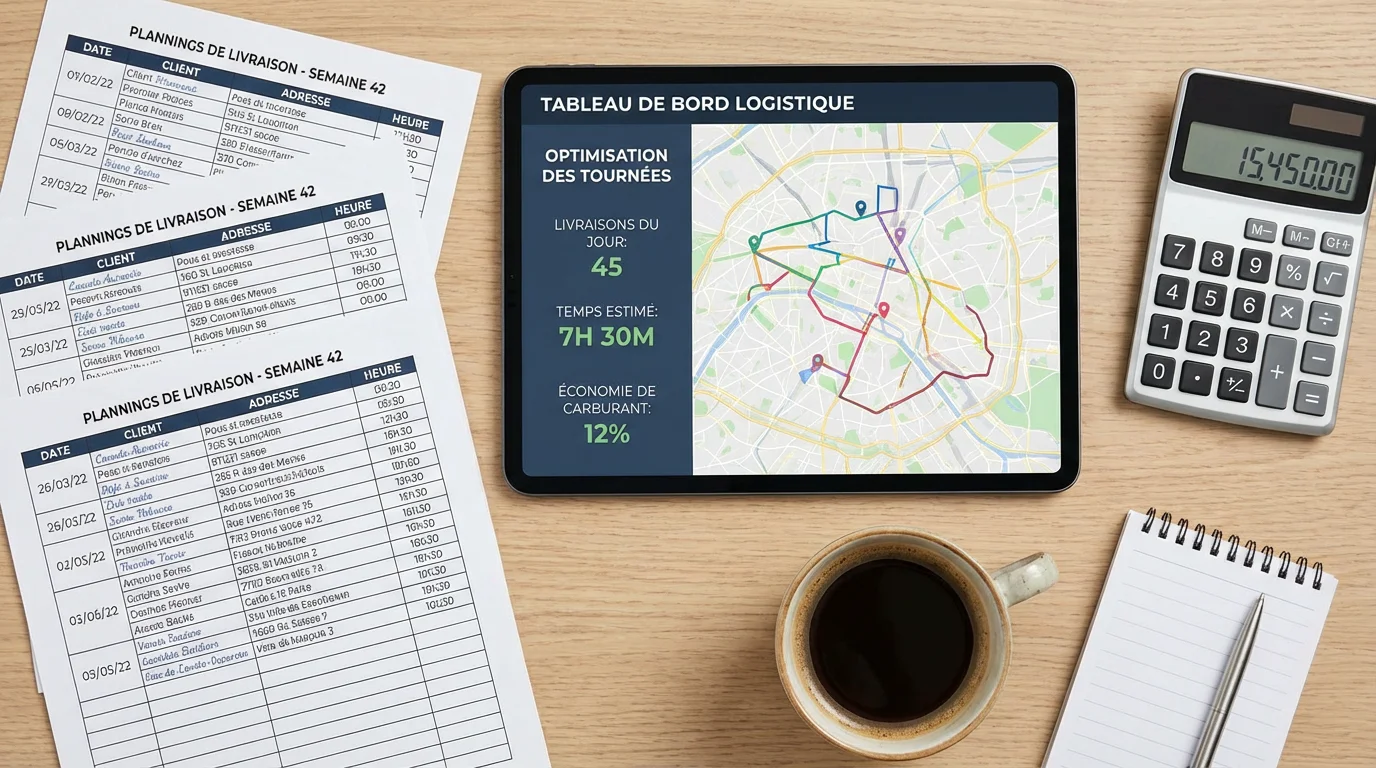
Not all market solutions meet the same needs. Several criteria help distinguish a suitable solution from an inadequate one.
Ease of Use
A complex tool slows adoption by field teams. The interface must be intuitive, both for the planner and for the driver on their mobile app. Training time is a reliable indicator: the shorter it is, the more ergonomic the software.
Optimization Algorithm Power
The core of any optimizer lies in the quality of its algorithms. Key points to evaluate: the ability to handle complex multi-stop routes, real-time traffic integration, and automatic recalculation in the event of disruption (cancellation, last-minute addition, accident on the route).
Integration With Existing Systems
A high-performing optimizer must connect with your business tools: ERP, CRM, TMS, telematics systems. Open and well-documented APIs facilitate this interconnection and eliminate manual re-entry.
Scalability and Pricing Model
Whether you manage 5 or 500 vehicles, the software must scale with your growth. Examine the billing model (per vehicle, per route, flat fee) and identify any hidden costs associated with advanced features or additional integrations.
To evaluate these criteria in a structured way, you can audit and optimize your routes in a single day before committing to a solution.
Comparing Route Optimization Solutions in 2026
The French market includes several players. Here is an overview of the main solutions, ranked by their key strengths.
| Solution | Positioning | Estimated km reduction | Free trial | Best for |
|---|---|---|---|---|
| MapFlow | SaaS, TSP/VRP algorithms, intuitive planning | 20–30% | 30 days | SMEs to large fleets, delivery and logistics |
| AntsRoute | Simplicity, SMEs | Not disclosed | 7 days | Tradespeople, local authorities |
| TourSolver (Nomadia) | Ultra-customization | Not disclosed | No | Mid-sized companies, technical trades |
| PTV Route Optimiser | Large fleets | 7–17% | No | Long-distance carriers |
| OptimoRoute | Cloud, agile SMEs | Not disclosed | Yes | Delivery SMEs |
Our solution stands out with a 30-day full-access free trial, a 20 to 30% kilometer reduction through advanced optimization algorithms, and an interface designed for rapid adoption. For a deeper comparison, you can compare route optimizers directly.
Measuring the Return on Investment of Your Optimizer
Investing in route planning software is justified by measurable results — but you need to know what to track.
Key performance indicators (KPIs) to monitor include: kilometers driven per delivery, time window compliance rate, average cost per stop, number of deliveries per vehicle per day, and CO₂ emissions avoided.
In the third quarter of 2025, domestic road freight activity fell 1.4%, measured at 41.5 billion tonne-kilometres — its lowest level since the end of 2023. In a context of declining volumes, according to official SDES data, every productivity gain from optimization matters. To structure this monitoring, you can use dedicated metrics to measure the performance of your delivery routes.
Return on investment is typically visible within the first few weeks of use. Fuel savings and the increased number of stops per route generate economies that quickly offset the subscription cost.
Common Mistakes to Avoid During Deployment
Choosing a good optimizer is not enough. Several pitfalls can limit the expected benefits.
Neglecting data quality: software can only optimize what it is given. Incomplete addresses, imprecise time windows or outdated vehicle information degrade result quality. Database reliability is a prerequisite.
Overlooking team onboarding: adoption by drivers and planners determines project success. Appropriate training and responsive support make the difference between a tool used daily and software abandoned after a few weeks.
Underestimating the importance of technical integration is another common mistake. An optimizer disconnected from your ERP or TMS creates duplicate entries and inconsistencies. System interconnection must be planned from the outset.
Finally, failing to regularly reassess routes represents a significant missed opportunity. Conditions evolve (new customers, changed opening hours, infrastructure updates). A regular route audit maintains a high level of optimization over time.
2026 Trends: The Future of Route Optimization
2026 confirms several major developments in the field of route management.
Predictive analytics is maturing. Algorithms no longer merely react to real-time traffic; they anticipate demand peaks, weather conditions and delivery behaviors to propose proactive routes.
The macroeconomic outlook for 2025 remains uncertain, with the French government having lowered its GDP growth forecast to 0.7% — a context in which logistics could face growing difficulties, according to Stratégies Logistique. This economic pressure is accelerating the adoption of optimization tools to protect margins.
Low-emission zones (ZFE) are multiplying in major French cities. Optimizers now incorporate these perimeters into their calculations, routing combustion engine vehicles toward compatible roads and prioritizing electric vehicles for urban routes.
System interoperability is also progressing. Optimization platforms are opening up through standardized APIs, making it easier to integrate them into complete logistics ecosystems (TMS, WMS, customer tracking tools).
In summary, the route optimizer is no longer a simple route calculation tool. It is becoming a pillar of logistics strategy, at the intersection of economic performance, customer satisfaction and environmental responsibility. In a French market where margins are tightening and expectations rising, the ability to optimize every route determines a company's competitiveness. Our planning solution offers a 30-day free trial to measure these gains on your own fleet. To take action, explore our optimizer's features and see the difference from the very first week.
Frequently Asked Questions
What Is the Difference Between GPS Navigation and a Route Optimizer?
GPS calculates the route between two points. A route optimizer organizes an entire working day: stop sequencing, vehicle assignment, time window compliance and constraint management. It is a global planning tool, not point-to-point navigation.
How Long Does It Take to See a Return on Investment From a Route Optimizer?
Return on investment is typically seen within a few weeks. With our solution, the 20 to 30% reduction in kilometers driven generates fuel savings that quickly offset the subscription cost. The 30-day free trial lets you verify this with no commitment.
Does a Route Optimizer Work for Small Fleets?
Yes. Even with 3 to 5 vehicles, the gains in planning time and avoided kilometers are significant. Current SaaS solutions offer pricing suitable for small organizations, with no heavy upfront investment.

